rules & regulations
LET'S LEARN HOW TO PLAY AND HAVE SOME FUN.
WHOSE READY TO DODGE SOME BALLS?
RULES & REGULATIONS
Players who do not abide by the rules and regulations herein will be disciplined within the confines of the sport up to and including being removed from play. No refunds will be administered due to disciplinary action from infractions.
By refusing to follow the rules, regulations and code of conduct you will forfeit your right to play in any WeHo Dodgeball leagues. You may also be restricted from participating in any future WeHo Dodgeball open gyms or social events.
Every player in WeHo Dodgeball will be held to the highest ethical standard while on court. Anyone found repeatedly violating the honor system will be carded and possibly removed from WeHo Dodgeball. Cheating and aggressive behavior is not welcome.
WHO’S READY TO DODGE SOME BALLS?
First and foremost, all of us are here to have FUN! While dodgeball can be a competitive sport, it is important to remind ourselves that we are all adults running around in silly outfits while throwing balls at each other. Please try to maintain a level head and a positive attitude at all times. Please do not confuse competition with aggression.
Violent and aggressive behavior will not be tolerated at any time.
*Management reserves the right to make decisions in the spirit of fairness, even if a strict interpretation of the rules indicates a different ruling.
HONOR SYSTEM
In dodgeball, possibly more so than any other sport, the honor system is key!
If you realize you have been hit by a ball and you're out, go out!
If you see that a teammate has been hit by a ball and is out, let them know!
Not following either of these codes of conduct is considered cheating.
The referee not calling you out does not remove your obligation to go out if you have been hit or if your ball has been caught.
The referees do NOT owe you an explanation to their calls.
Remember! Your integrity is not worth a point in an adult recreational dodgeball league!
DODGEBALL IS A CONTACT SPORT!
It is important to remember that the overall objective in Dodgeball is to throw a ball in an attempt to hit the opposing team. Every player will eventually get hit by a ball. Occasionally that hit may be harder than a person expects. WeHo Dodgeball has several rules in place to ensure a player’s safety. It is important that every player familiarizes themselves with the rules so that we can create as safe as an environment as possible.
how to play
+ Equipment
THE BALLS
WeHo Dodgeball is played with people-friendly “no-sting” soft rubber balls. While they aren’t the giant red monsters that you used to get beat up with as a child, please be aware that any object hurled at high speeds can still smart a little if and when it connects with your frail human body. This is a contact sport.
+ Outfits
We strongly recommend you play in form-fitting, breathable clothing that you find easy to move in. Most teams will organize a team uniform t-shirt paid for outside the cost of the season.
Appropriate footwear is required. Shoes cannot leave marks on the court or you may be removed from the game. No dress shoes, high-heels, crocs, flip-flops or bare feet allowed.
Occasionally teams will elect to play in themed costumes. While we encourage this kind of participation, please note that any costumes:
- Must not include a substantial large design element that can swing about freely and that may possibly be hazardous to the well-being of other players on court with you.
- Must not substantially impede your vision (including peripheral).
- Must not be so heavy as to risk overheating, nausea, or heatstroke.
Please Note: Clothing counts! Keep that in mind when choosing your team costumes.
Gloves, Tape, Kneepads, Sport Goggles and other protective gear are strongly encouraged. Players may use liquid chalk for grip but not anything that may come off onto the ball.
+ Teams
Every team has a roster of up to 18 players. However, only 16 players are allowed on the court at a time. If more than 16 players are present for a match, it is up to the team’s captains to coordinate players rotating in and out.
Additionally, a team must have a minimum of 3 women-identifying players. No team can field more than 13 male or non-binary identifying players on the court at one time.
+ Captains
Each team will designate two of their players as captains for the season. Captains are responsible for coordinating the following: Covering the team’s referee responsibility for the season
- Team names
- Team uniforms
- Weekly team communication
- Replacement players
Captains will act as liaisons between the team and the referees & league admin.*
*Please note: This does not mean captains are allowed to yell, scream, or curse at the referees. Unless of course they want to guarantee that they get red-carded. Then, by all means, go nuts.
Non-captains are absolutely, positively not allowed to communicate with referees during a match.
+ Matches / Scoring
A standard WeHo Dodgeball match consists of a 45-minute time period, during which two teams compete in as many games as time permits. A game ends when one team has completely eliminated the other from play. Every game won will be scored as 1 point. The team with the most points at the end of a match is the winner.
If match time expires in the middle of a game, that game is declared void.
Tie games are possible in regular season games. If teams are tied in an end-of-season tournament game, that match will enter overtime and, if necessary, sudden death.
Teams are required to switch court sides at the first opportunity between games after 22 minutes
+ Start of Game
A standard WeHo Dodgeball league match is played with 7 balls. All 7 balls will be placed along the court’s center line—three on each side. Possession of the remaining 7th ball will be determined by the captains "ro-sham-bo".
Captains will ro-sham-bo to determine which match advantage each team starts with. The captain that wins may choose either ball control or which side of the court they want to start on. If the captain chooses ball control, the four balls will be placed on the right side of their team's court. The remaining three balls will be placed on their left side (and, correspondingly, the opposing team's right side). All balls must be placed within 6 feet of the sideline.
The layout will be reversed at the opening of the next game, and then again, alternating back and forth every game until the match time expires.
If the captain chooses court control, they may choose which of the two court sides they wish to begin the match on. Whichever option the winning captain does not select is deferred to the captain who lost ro-sham-bo.
At the start of each game, all players on court must line up along the back line of their side of the court. Players must maintain contact with the back line until the referee’s starting signal.
On the referee’s signal, players may run to retrieve any of the balls within their initial control - that being only the balls on their right. This initial scramble is known as the “rush”. During the rush (and only during the rush), players may inadvertently step over the center line.
Please note: Players may not slide, feet first, to the line to grab balls in the opening rush.
Please note: Running for the balls before the referee’s signal (known as a false start) may result in a team losing ball control or the infringing player(s) being declared out.
All balls must clear the attack lines before they can be brought into play. This is done one of two ways:
- A player crosses the attack line with both feet while carrying the ball.
- A player tosses the ball to another player already standing behind the attack line.
Any ball thrown without clearing the attack line will be declared a dead ball. The team that threw the ball will not get that ball back.
Players who repeatedly throw without clearing the ball may be given a warning, then called out.
+ How to Win
A team will be declared the winner of a game when all of the other players have been eliminated from play. When a player has been eliminated from play, that player is said to be out. A team will be declared the winner of a game when all of the other players have been eliminated from play. When a player has been eliminated from play, that player is said to be out.
You can be eliminated by an opponent:
- If a live ball is thrown and it makes contact with you or your clothing without being caught.
- If they catch a ball you throw offensively.
Or you can be eliminated by making infractions against the rules:
- Ex: Touching the opposing team’s court (crossing the center line).
- Ex: Jumping or dodging out of bounds.
- Ex: Demonstrating poor sportsmanship.
WeHo Dodgeball “mercy” rule: A team may attain a maximum lead of 8 games. When that happens we will end the game, declare the winner and then mix the teams up for the remainder of the match time. (ex: mercy rule is enacted when the score is 8-0, 9-1, etc)
+ Catches
When a player catches a (live) ball thrown by an opposing player, they are not only eliminating the player who threw the ball —they are also allowing the first person waiting in their own team’s outline to re-enter the game.
A catch is only valid if both of the catching player’s feet are within bounds and they clearly demonstrate control of the ball before releasing it.
If a player makes a catch with 2 feet in bounds and then fall out of the court they are:
OUT - If they fall on out of the sidelines or across the middle line
SAFE - If they fall back over the back line
In both instances, the catch counts.
A ball caught in the air will count as a catch IF it is clear the player possesses control of the ball and that they will safely land in-bounds with two feet.
Please note: If a player has a ball in their hands and catches another ball, the player must maintain possession of both balls. If a player releases the ball in their possession to make a catch, players must adequately demonstrate to the referees that they purposely relinquished control of the ball in possession prior to making the catch.
Please note: A trap is when a ball is caught while making contact with the floor or part of the building at the same time. Traps do not count as a hit or a catch and both players are considered safe
+ Deflections / Blocking
A player may use their ball to block oncoming balls thrown at them by the opposing team.
Players must maintain possession of their ball immediately after deflecting a live ball. If a player drops a ball used for a deflection, due to the impact of the thrown ball, that player is out. (Unless that player, or a teammate, catches their ball before it hits the ground and becomes “dead”, then the player is safe).
A ball that is deflected is still a live ball and can still eliminate other team members (or the blocking player) on contact or be caught to eliminate the person who threw the ball.
Please note: Your hands are an extension of you. If your hands or fingers get hit while attempting to block a ball, you will be called out! This is where the honor system comes into play the most!
+ Throwing
The surest way to eliminate an opponent is to throw a ball at them. The keyword here is throw. Balls that are kicked, spiked, punched, belly bumped, rolled or spit out are not valid forms of offense. (see also: Ball Control/Countdown)
A player must have control over their throw, if a referee feels the player does not have control, they will be warned and then potentially called out.
“Spin” throws are not allowed. (where a player spins around and releases the ball)
A player must perform a valid throw for the throw to count towards ball control count down.
+ Live Ball / Dead Ball
A thrown ball is said to be “live” once it leaves a player’s hand and crosses the center line. A live ball can either eliminate opposing players by coming in contact with them or be caught until it becomes a dead ball.
A ball becomes a dead ball by:
- Coming in contact with any part of the court or building.
- Coming in contact with another ball traveling through the air.
- Coming in accidental contact with an eliminated player.
- Coming in accidental contact with a non-player.
- Directly impacting on an opposing players head (see “Headshots”)
- Being caught by an opposing player.
- Crossing the center line off either a deflection or after coming into contact with an opposing player.
Once a ball is dead, it stays dead until it is thrown offensively again.
+ Pinching
Pinching is defined as manipulating the ball so that rubber touches rubber. Pinching is not allowed in WeHo Dodgeball. The player will be warned, then called out.
+ Headshots
A direct headshot (that is—a ball that travels directly from an opposing player’s hands to a defending player’s head) will result in the ball immediately becoming a dead ball.
There are a number of exceptions to this rule, including:
- When a player has more than 2 points of contact with the ground. (Each foot, each knee, each hand, and each elbow is considered one point of contact. Your big ass booty automatically counts as three.)
- When the ball has been previously deflected off of another body part, player or ball.
Players struck by direct headshots are not out unless they are struck simultaneously (or nearly simultaneously) with other live balls.
Standing Headshots
If a player throws a standing headshot (Hits an opposing player in the head when they are standing straight up) the thrower is out. If the opposing player is crouched below their own shoulder height, then the thrower is not out and the player is still safe.
- The standing headshot rule is in effect even for players in the outline. At no point should any ball be thrown at head height and this rule applies even when an “out” player or referee is hit in the head.
Players who are hit in the face may remove themselves from play for up to two minutes (at the referee’s discretion) in order to compose themselves and make sure they are still able to physically continue. However, if the player’s team is eliminated while they are still off court, the game will be declared officially over.
Deliberately throwing at a person’s face is not allowed under any circumstances. Players caught “headhunting” will be removed from game play. This includes players who repeatedly throw close to opposing players’ heads and continue to do so after they have been warned by a referee.
Deliberately using your head to block balls is also not allowed. If a referee believes a player is using his head to deflect offensive throws, that player will be declared out.
Please note: A ball caught against a player’s face is not considered a headshot and will count as a catch.
+ Ball Control / Countdown
When a team has majority possession of the balls in play, that team is said to have ball control. Players that hold the balls out of bounds for teammates is also considered possession.
Once a team gains ball control, that team has 15 seconds to relinquish majority possession. Failing to give up ball control within the 15 second time period will result in referees stopping play and awarding the other team possession of all balls.
The 15 second time period resets as soon as a team throws enough balls to give up majority possession. If balls are thrown and immediately bounce back, giving the same team majority possession, the 15 second time period will immediately reset.
Please note: Players must perform a valid throw in order to relinquish ball control. Balls may not be rolled or placed by hand over the centerline.
If a ball rolls over to the other side, then that will also count towards relinquishing of ball control.
If a referee determines it was not a valid throw, the player will be warned on first offense and then called out.
+ Out-of-Bounds
Live players must generally stay within the boundaries of their side of the court.
LEGALLY EXITING THE COURT
A player may only exit the court in order to retrieve balls that have bounced or rolled out-of-bounds. A player may only enter or exit the court from the rear “back line” of the court. Players who enter or exit through the sides “illegally” will be called out.
Players may not exit their court if there is no ball out-of-bounds. They may not exit the court until the ball passes the out-of-bounds line. Exiting a court in anticipation of a ball that is headed for the out-of-bounds zone is not allowed and the player will be called out.
Once out-of-bounds, a player has 10 seconds to retrieve a ball and return to their side of the court. Failure to return within 10 seconds will result in that player being eliminated from play.
Players may not carry a ball from their court to the out-of-bounds zone. They may however collect and carry as many out-of-bounds balls as they can within the 10 second time period. Carrying a ball into the out-of-bounds zone will result in that player being eliminated from play.
Players who are in the out-of-bounds zone absolutely may not reach into the court for any reason. If a player reaches in bounds from the out-of-bounds zone to pick a ball, that ball will be rewarded to the opposing team. If a player reaches in bounds to interfere with an ongoing play, they may be penalty carded.
*** SEE COURT BOUNDARY GRAPHIC BELOW ***
Players who have legally gone out-of-bounds to retrieve a ball are safe and cannot be eliminated until they step back on to the court with both feet.
The last live player on a team cannot exit the court for any reason. If a player is the last live player on their team and exits the court for any reason, the other team will be declared the winner of that game.
DODGING / CATCHING OUT OF BOUNDS
Players cannot dodge out-of-bounds. If a player moves out of bounds in order to avoid being hit by a ball, that player will be called out. Players must have one foot completely crossing the line to be declared out-of-bounds. (See attached image below)
Players who step or fall out-of-bounds while catching an opponent’s ball are:
OUT - If they fall or step over the side lines
SAFE- If they fall or step over the back line.
Whether the catch is valid depends on when the defending player successfully demonstrates control of the ball. If they demonstrate control of the ball while both feet are still within the boundaries of the court, the catch is valid. If a player’s foot is outside of the court boundaries before they take control of the ball, the catch is invalid and that player is out
CENTERLINE
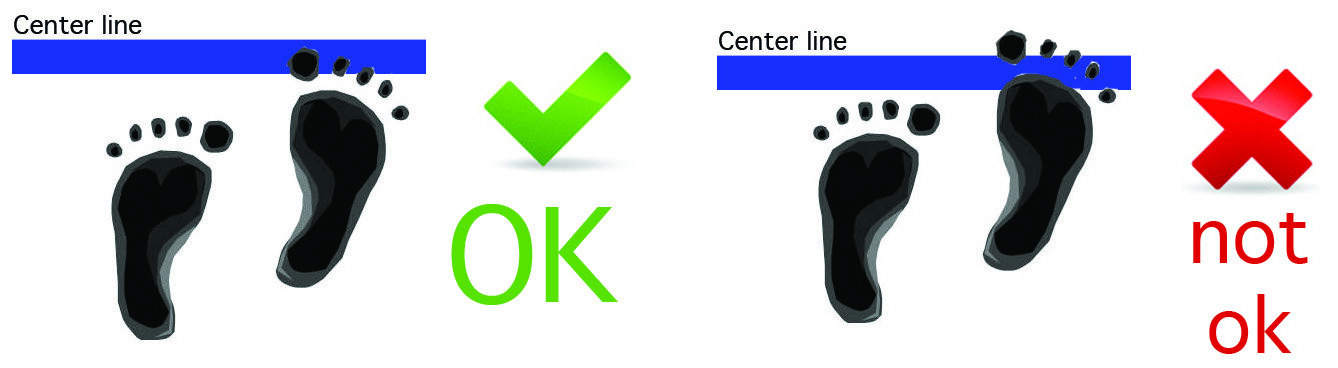
While IN BOUNDS players may reach across the centerline in order to retrieve a ball, they may not make contact with the floor of their opponent’s court. Touching the floor of the opponent’s court will result in a player being eliminated from play.
Please note: The centerline “extends” across the length of the entire gymnasium. Players may NOT reach or cross over the center line while out of bounds for any reason.
For safety reasons, jumping across the line in an attempt to hit the opposing team before you hit the ground (known as a suicide play) is not allowed in WeHo Dodgeball.
THE OUTLINE
Once a player is eliminated, they must immediately proceed to their team’s outline, located out-of-bounds to the side of that team’s court in between the courts.
Ex: Out line is between courts 1 & 2, and between courts 3 & 4 (see court diagram below)
The first person standing in the outline is the first person eligible for re-entry upon a catch, even if they were not eliminated first. You MUST make an effort to get to your proper place in the outline, however if another player is hit right after you and gets to the outline first, they will be the first to be allowed to come in.
As soon as a player is eliminated, they can in no way interfere with the ongoing game. This means no swatting oncoming balls or kicking or passing balls to fellow team members as they exit the court. If an eliminated player interferes while exiting the court, possession of that ball will go to the other team.
Players must line up in the order that they reach the outline. Line jumping (in which one player cuts in front of a teammate who was eliminated before they were) may result in yellow carding of all involved and forfeiture of the ongoing game.
If a player mistakenly enters the court out of line:
- If that player does not interfere with the game in any way: They will be removed from the game and have to go to the end of the out line and no other player will be allowed in on the catch
- If that player interferes with the game (ex. Grabbing a ball or catching a ball) that player will be removed and the game will be forfeit. The referees will award a point to the opposing team and start a new game.
Players who leave the outline forfeit the ability to be caught back in during that game. If there are three players or less in the outline, a player cannot leave the outline, even to shag on the other side of the court. Doing so may result in that player being ineligible to come back into the game.
Players must already be standing in the outline with both feet in order to come back into a game. If a player is hit and their teammate makes a catch before they reach the outline, they will not be allowed back in on that catch.
Players have 5 seconds from the moment their team makes a valid catch in which they can come back into the game. If the player does not enter the court within that time, they will be deemed out and must move to the back of the outline. No new player may enter on that catch.
A player becomes active upon re-entry as soon as they step in-bounds with both feet.
Other than shagging balls out-of-bounds, players in the outline may not interfere with the game at any time, for any reason.
Please Note: For safety reasons, once you have been eliminated, please drop any ball you are currently holding, raise your hand to notify all other players that you are out, and walk quickly and directly to the outline, while watching for incoming throws. It is your responsibility to protect yourself while walking to the outline.
+ Shagging
Both eliminated and alternate players may shag balls for their teams while in the out-of-bounds zone. This means that they can retrieve any ball on their side of the court in the out-of-bounds zone and make them available to live players on their team.
Shaggers may not:
- Reach in bounds for any reason. Reaching in bounds for a ball will result in the ball being awarded to the opposing team.
- Roll or throw balls into the opposing court.
- Stand behind the backline to shag. You may “tennis shag” i.e: run and grab the ball and then return to the side of the court.
Players may shag balls only while standing on their own side of the court. Players may not reach for a ball on the opposing team’s side of the out-of-bounds zone.
Players may hold a ball out-of-bounds in order to wait for an ideal time to pass to a teammate, however once a team has possession of a ball, that will count towards the ball control countdown.
+ Injuries
Players who are injured during the course of play may remove themselves from play for up to two minutes (at the referee’s discretion) in order to compose themselves and make sure they are still able to physically continue.
Please note: If the player’s team is eliminated while they are still off court, the game will be declared officially over.
If a player is unable or unwilling to continue after two minutes, the first person of the same gender identity in the outline will be allowed to take their place. If there is not a player of the same gender identity in the outline, then the next person in line may take their place. If there are no players in the outline then an alternate rostered player may take the injured player’s spot.
+ Stalling
Teams must deliver the balls to the opposing side in a manner that the opposing team has an opportunity to take possession of the balls. Invalid throws, balls that are consistently and deliberately thrown out of bounds or at the ceiling in a way so that they bounce over the opponents heads, is considered “stalling”. If a referee concludes that a team is stalling, they will deliver one verbal warning. If a team continues to stall, the referee will order them to relinquish all balls to the opposing team.
+ Time Outs
Both teams are allowed one 30-second time out per match. Team captains are the only players who can call for a time out.
During a time out, eliminated captains (and captains only) may step on to the court in order to address any live players.
Referees will give one warning to “out” players who step on the court. If they continue to do so the player will be yellow carded.
No player on either team may use a time out to gather balls or manipulate the court in any way.
Time outs are given at the referee’s discretion. A time out is not official until the referee’s whistle is blown, at which point all game play is stopped and all balls are declared dead (even if in mid-air).
+ Referees
Referees are here to ensure the integrity of the game. A referee’s main priority is to keep the game moving and to rule on any unclear plays.
It is not a referee’s job to police you. You are expected to follow all rules and regulations whether a referee sees you or not.
All referee calls are final.
Referees do not owe players an explanation for their calls.
While captains may calmly discuss a play with a referee (within limits), no players are allowed to argue with or berate the referees. Captains need to express their concerns with the referees quickly and calmly. Captains cannot pull the referees’ focus from the game for a considerable amount of time.
Captains may NOT stop play/time clock in order to argue a call with a referee. Game stoppage is at a referee’s discretion.
Any undue behavior towards referees will result in penalty cards.
+ Penalty Cards
Players who persistently refuse to abide by the above rules will face discipline at the referee’s discretion. Discipline may begin with a verbal warning and escalate to a player being issued a penalty card.
YELLOW CARDS
A player who is issued a yellow card is automatically declared out if they are a live player and will be forced to sit out the remainder of the game in session and for the length of the following game. That players team will not be allowed to replace them for the game and will play down one player.
If a player receives a yellow card in the final game of a match, they will be required to sit out in the first game of the following week’s match.
Players who receive two yellow cards in one match will automatically receive a red card.
RED CARDS
A player who is issued a red card will be forced to sit-out the remainder of the match in session.
If a player receives a red card, they may be subject to suspension and/or expulsion from the league at the discretion of the league managers.
Suspended players may not be replaced by their team and the team will be forced to play down.
Players who are expelled from the league are not eligible for refunds of any kind.
+ Player Conduct
We’re all technically adults here. (Even if your league manager does like to wear underoos.)
As adults, you are all expected to treat everyone else in the league with respect and dignity. This means all of the following is absolutely unacceptable:
- Picking arguments over dodgeball in our sponsor bars.
- Picking arguments over dodgeball on publicly traversed social media sites like Facebook, Instagram or YouTube.
- Verbally or textually berating or using derogatory or racist language towards your teammates or other players in the league. (This includes social media accounts!)
- Physical violence of any kind on court or in our sponsor bars.
WeHo Dodgeball has a ZERO tolerance policy for violence.
Any player found to be engaging in any of these behaviors will be disciplined accordingly.
+ Substitute / Replacement Players
SUBSTITUTE PLAYERS
In the event that a player cannot attend a match, the team may replace them with a substitute player for the evening. All substitute players must sign a waiver and pay a $10 fee to be eligible to play. All substitute players are subject to approval by a league manager.
The $10 fee is per match. Subs can play on multiple teams per night, but must pay for each hour.
Teams may not bring in subs in order to "stack" a team. Rostered players take priority and cannot sit a game out in order to make rooms for substitute players.
Games played with an ineligible substitute player are subject to forfeit. Forfeits can be applied retroactively.
- Substitute players are responsible for knowing the rules before they enter the court.
- Substitute players cannot be rostered players from other teams within the league on that night of play.
- Substitute players who receive yellow cards may be deemed ineligible to play.
REPLACEMENT PLAYERS
Teams may replace rostered players if: - The player is injured and cannot continue playing.
- The player has not attended 4 or more matches and has not communicated with the team or given the team ample time to find a substitute.
All replacement players must be added before Playoffs. Any players who are injured or forced to drop out after the cut-off time cannot be replaced.
Players who are injured after cut off time cannot be replaced.
All replacement players are subject to approval by a league manager.
More information on replacements is available in the captain’s packets.
+ End of Season Tournament (Playoffs & Finals)
Every season customarily ends with a single-elimination tournament to declare the season champions. The tournament typically takes place over the final two weeks of season, with the first week being declared Playoffs and the second week consisting of the Semifinals and Finals.
The tournament bracketing system will vary depending on the type of league. The game schedule will be announced at least one week prior to the playoffs.
+ Standings
Standings are determined by the number of matches won by a team. If two teams have the same amount of win/loss/tie then their order in the standings will be determined by head-to-head. If the teams tied when they played each other, or if they haven't played each other, then the standings will be determined by total game win/loss.
If teams are still tied at that point, standings will be determined by a coin toss.
+ Overtime / Sudden Death
Due to the single-elimination nature of the tournaments, tie games are not allowed.
If a tournament match sees time expire with a tie score, that match will enter overtime.
Overtime consists of a 4 minute period of play. Both teams start with a full roster. If a team cannot field all 16 players, they start with as many players as they can field.
Overtime will begin as a new game, with ball control shifting teams per usual.
When the 4 minute time period expires, the team with the most live players left on court will be declared the winner.
*Note: At the end of the 4 minutes all "out" players must remain off the court until a referee has called the game. Failure to do so MAY result in a forfeit (at League Manager's discretion).
In the event that both teams have an equal number of live players, the match will pause, then continue with the remaining players and enter a period of Sudden Death. The first team to have a player eliminated will have lost the match.
+ End Of Game
At the end of the match the referees will initiate a 10 second countdown. At the end of the countdown, once the refs blow the whistle, all balls are considered "dead" and the match is over. Teams are then encouraged to high-five and head to the after party!
+ Additional Conduct Rules & Regulations
Due to safety reasons, players who are visibly intoxicated or high will be removed from the game and the gym. You may not bring alcohol into the gym. Reminder that it is illegal to consume alcoholic beverages, or smoke, in a public park or city facility.
Do NOT engage in discussing calls or confronting players about the game at the bar. Remember the bar is for socializing and after a few drinks is the WORST time to try and argue a call or re-live a play. Please remember the code of conduct extends to the bar.
+ Filming
We enthusiastically support our players in capturing photos and videos during their games to document exciting moments. However, we strongly discourage and restrict any footage intended to bully, antagonize, embarrass, or undermine players in our leagues or at any WeHo Dodgeball event. When utilized appropriately, media becomes a powerful tool for promoting the sport, uplifting one another, and inspiring improvement. We are committed to fostering a positive culture, and the use of media for negative purposes contradicts our media policy.
Upon joining WeHo Dodgeball, each player has signed a photo and video release. Nevertheless, we retain the right to remove or ban any filming if we observe it being improperly used. Our goal is to maintain a respectful and supportive environment for all players.
Players are prohibited from posting videos of other participants on their social media without their consent. Reminder that this is NOT a public space. You must legally obtain consent for all videos you post, especially if you are attempting to monetize your social media channels. Failure to abide by these regulations will result in permanent suspension from all WeHo Dodgeball events and leagues.
Reminder that no referee can catch everything. Some mistakes will be made. Video “evidence” is not allowed for reffing purposes. We have a zero-tolerance policy of players posting videos to attack players you believe didn’t follow the rules. No sporting event in the history of the world gets every call correct. By participating in WeHo Dodgeball you acknowledge that even the refs are human, mistakes happen, we cannot turn back time (yet) and the purpose of this event is to come together to play, meet new people and have fun. Engaging in accusatory “debate” online after the fact is not only pointless, but a violation of our code of conduct.